

When The Night Changes
Summary
This body of work brings together visual art and cultural research exploring the night festivals of Shivraatri, and Jouvay in Trinidad and Tobago. It considers festival traditions as evolving and dynamic practices through which cultural equilibrium is continually negotiated. By examining how distinct traditions coexist, intersect, and generate different meanings while sharing cultural and social spaces, the work explores the possibilities of balance amid difference and change.
The work has been exhibited and presented at the following exhibitions and conferences:
-
This visual work was developed during the Central Bank of Trinidad and Tobago Museum, Creative Residency Programme.
-
Title of Paper: Above War-Ta Visual Art Presentation : Co-imagining Caribbean Colonialism through the Samudra Manthan
Hosted by The University of the West Indies (The UWI), St. Augustine Campus (Faculty of Humanities and Education
-
Location : Edna Manley College of the Visual and Performing Arts
Title : When the Night Changes: Shivratri and Jouvay in Trinidad and Tobago
Conference Panel : Transforming Self and Community in Caribbean Ritual and Festival Traditions
-
Drawing on the principles of chemical equilibrium, I explore festivals as sites of cultural encounter. Using the metaphors of homogeneous and heterogeneous equilibrium, I investigate encounters between traditions within shared cultural contexts.
Introduction
In Trinidad and Tobago, religious festivals and cultural spectacles illuminate the complex social, political, and spiritual tapestry of a multicultural society. This work explores the intersections between Jouvay, the pre-dawn celebration of Trinidad and Tobago’s Carnival, and Shivratri, a Hindu night festival dedicated to Shiva. Often simultaneously occurring, both celebrations bring people together through music, movement, ritual, and embodied forms of expression that continue through the night and into the morning. Although they emerge from different cultural and spiritual traditions, their temporal and spatial intersections offer an opportunity to consider how festivals shape individual and collective identities.
My personal connection to this inquiry stems from childhood memories of observing both celebrations. I attended a Hindu school, where I learned about Hindu festivals, although my family did not practise these beliefs. We lived only a few lots away from a temple, and I remember hearing its drums during Shivratri celebrations that continued throughout the night and into the morning.
I also have a vivid memory of one Jouvay morning, watching from the gallery as a troupe of Blue Devils passed the temple on their way to the town of Sangre Grande. The temple’s rhythmic drumming filled the air as the masked moved through the streets. In this moment, two distinct cultural expressions occupied the same landscape, creating a sensory encounter that has remained with me.
As I grew older, I experienced Carnival and Jouvay from a different position: riding on a music truck, several degrees removed from the masqueraders themselves. Accompanying my father, who supplied music trucks and sound systems for the rural coastal village of Grande Riviere, was a family tradition. My relationship with Carnival therefore developed through different positions within the festival, moving from observer to participant and encountering the celebration through sound, movement, and proximity to the procession.
These memories inform my interest in festivals as spaces where identity is continually negotiated through the body, the environment, and collective participation. They also prompt questions about how people inhabit shared spaces while carrying different histories, beliefs, and cultural affiliations.
JOUVAY ⇌ Shivraatri
For Hindu devotees, Shivratri can be a time of devotion, reflection, and spiritual aspiration, including the pursuit of moksha, or liberation. The observance provides opportunities for self-examination and participation in a religious community. Jouvay, meanwhile, transforms the streets through pre-dawn masquerade, music, and the application of paint, powder, mud, and molasses to the body. Often described as a ritual of sunrise, it foregrounds the body as a site of performance, transformation, and collective expression.
Shiva, associated with dance and destruction, is understood in Hindu traditions as a force through which illusion and impermanence are confronted and transformation becomes possible. His depiction covered in ash can evoke the transient nature of material existence. In Jouvay, the body is similarly transformed through substances that alter its appearance and relationship to public space.
These parallels do not make the two traditions interchangeable. Rather, they offer a way to consider how distinct practices of transformation may resonate with one another when they occupy the same cultural landscape. The intersection of Jouvay and Shivratri in Trinidad and Tobago raises questions about coexistence, cultural memory, and the ways people create meaning within a plural society. Their proximity becomes an opportunity to explore how traditions can remain distinct while contributing to a shared environment.
Presented at 7th Rex Nettleford Arts Conference, Oct 2023
Location : Edna Manley College of the Visual and Performing Arts
Title : When the Night Changes: Shivratri and Jouvay in Trinidad and Tobago
Conference Panel : Transforming Self and Community in Caribbean Ritual and Festival Traditions
In this paper, I explore Carnival festivities, specifically jouvay and the Hindu festival of Shivratri. rooted in the comemoration of the Shiv Baraat. I investigate the relationship between Indo and Afro-Caribbean cosmologies by comparatively discussing the histories, rituals and festival space. Against this background,Shared themes of birth, destruction and renewal, the use of popular theatre, and community participation, feature in both Carnival and Shivratri.
The data collected in this discussion draws from six (6) semi-structured, in depth interviews with festival practitioners. In addition to discussion, I include my visual art representations of the co-imaginations of Carnival and Shivratri in Trinidad and Tobago. This study is important to expanding the Caribbean cultural understanding of selfhood and community. It also preserves the voices of practitioners in key cultural traditions and practices.
SAMUDRA MANTHAN ⇌ Caribbean Colonisation

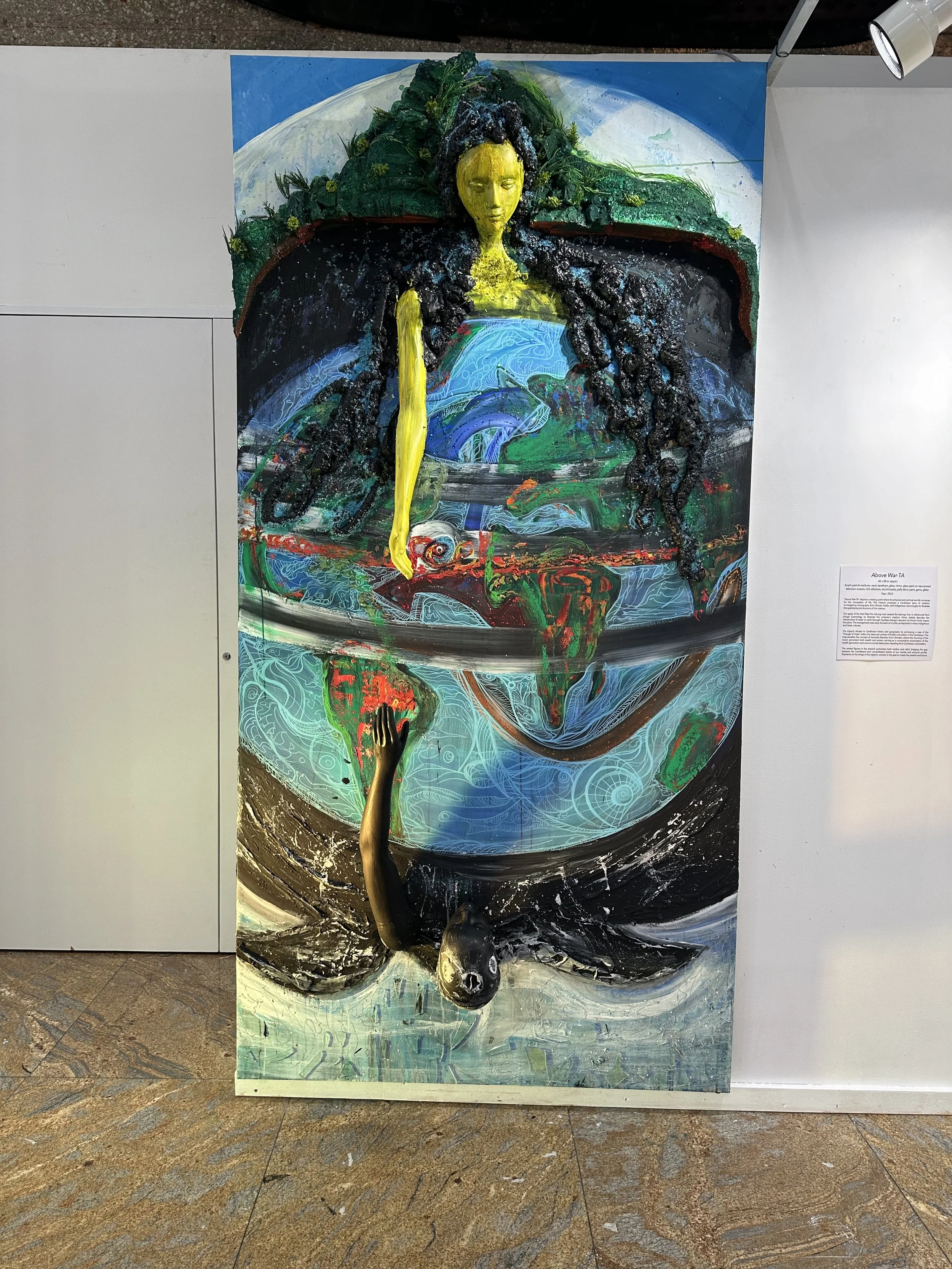
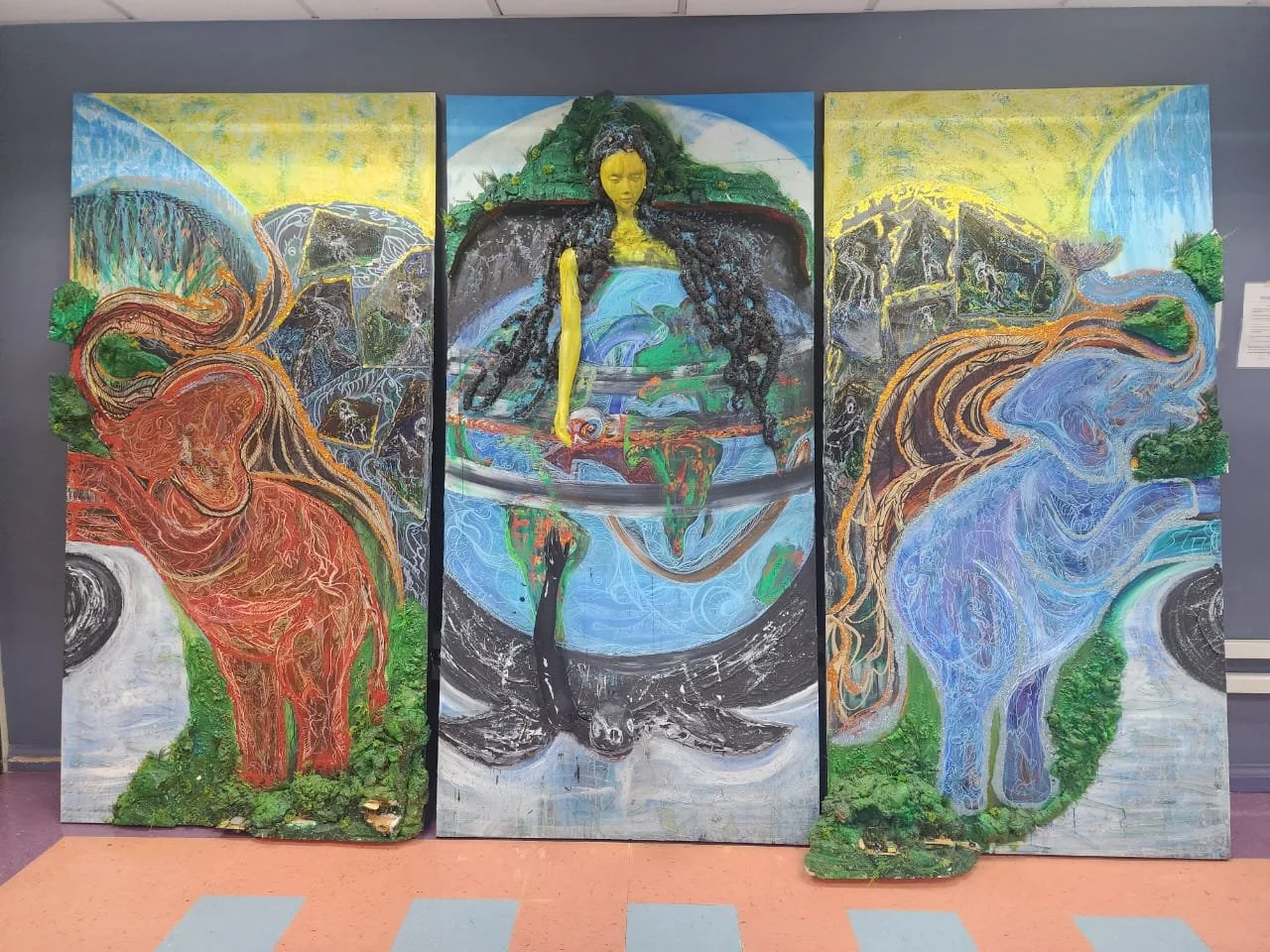
Title - Above War Ta | Size: Triptych each 4ftx8ft | Year: 2024
This presentation examines Caribbean colonization through the installation Above War-Ta, a visual artwork that co-imagines the region’s history through the lens of Hindu mythology. The work engages with the Caribbean’s complex entanglement of histories, religions, and ecologies by weaving together narratives of loss, rebirth
The installation maps the Samudra Manthan—the churning of the ocean in Hindu cosmology—alongside the historical Triangle of Trade. This parallel frames the violent circulations of empire, trade, and labor as a prolonged cosmic churning, where through the turbulence emerge both poison and the goddess Lakshmi, symbol of wealth and renewal. In this dialogue, Above War-Ta interprets the Caribbean’s colonial past as an ongoing process of creation entangled with destruction—where the quest for wealth produced ecological ruin, and yet, new cultural and spiritual forms.
The triptych reimagines colonial history as a dynamic negotiation among forces of creation, preservation, and destruction—echoing the triadic cosmology of the Hindu Trimurti in the Samudra Manthan. Within this framework, Indigenous, enslaved, and indentured peoples are not passive subjects of empire but co-creators of cultural continuity and transformation. Their practices of survival, ritual, and ecological adaptation are read here as forms of decolonial world-making that contest the logics of coloniality. Conversely, colonial regimes sought to impose order through extractive economies and environmental domination, producing cycles of both material accumulation and ecological collapse.
Above War-Ta positions the Caribbean as a cosmological and ecological crossroads—a site where histories of spiritual belief, labor, and environment converge in cycles of destruction and renewal. Drawing on decolonial methodologies of co-imagining and relation, the work seeks to reconstruct Caribbean narratives not through linear historiography but through layered temporalities of myth, memory, and environment.
The creative process itself operates as research through narrative building, assemblage, and participatory movement. The triptych—three canvases each measuring 4 ft x 8 ft—forms an immersive environment in which the spiritual and material worlds intersect. Audience members move through the panels, experiencing shifts in scale and perspective that mirror the oscillations between human and divine realms. The integration of augmented reality (AR) invites viewers to encounter the paintings through their phones, revealing alternate layers of imagery and sound that situate the work in “different times and places.” This use of AR extends the installation beyond physical space, creating a dialogic interface between ancestral cosmology and contemporary digital seeing. In doing so, Above War-Ta performs visual research into how Caribbean cosmologies might be reimagined as living, relational systems that inform ecological and political futures.
Title of Paper: Above War-Ta Visual Art Presentation : Co-imagining Caribbean Colonialism through the Samudra Manthan
Conference: Where Oceans Join: Landscapes, Seascapes, Archipelagoes in the Circum-Caribbean Ecologies
Hosted by The University of the West Indies (The UWI), St. Augustine Campus (Faculty of Humanities and Education

JOUVAY ⇌ Kambule + Baraat
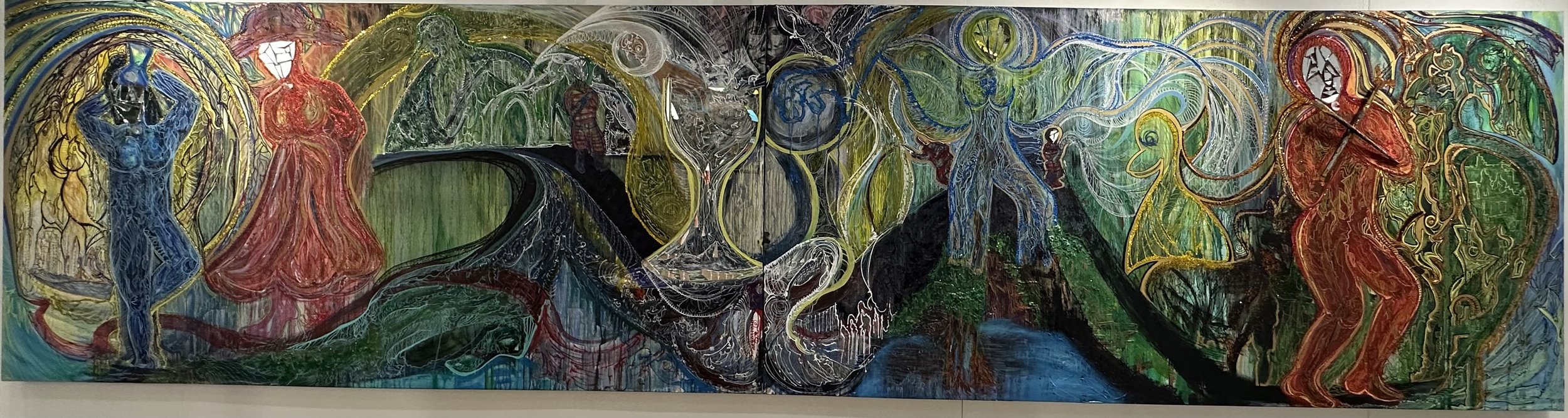
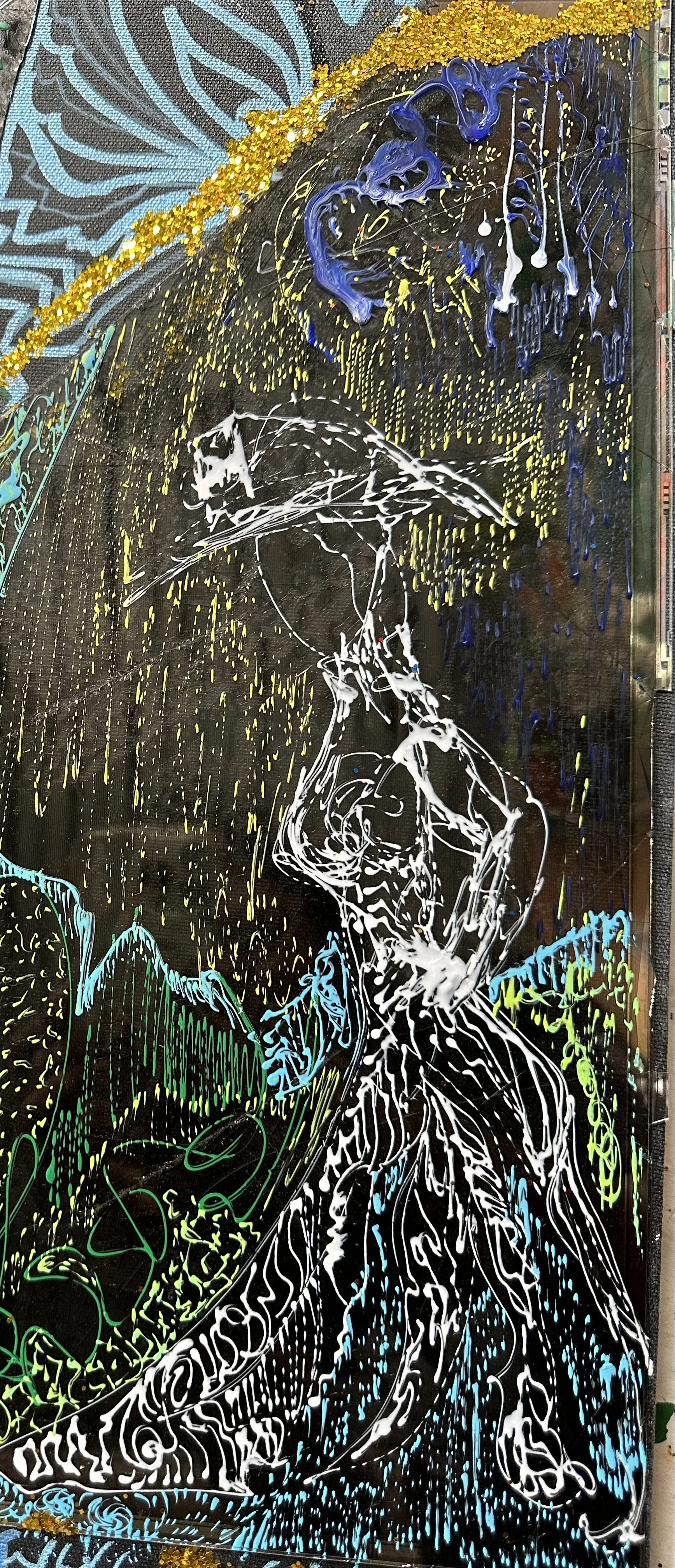
The parallels between Shiv Baraat parades in India and Jouvay in Trinidad and Tobago are illustrated to illuminate the rituals, characters and iconography of both cultures. The paintings depict space as made and imagined by people through social processes, confronting differences. In this diptych, migration is depicted through street processions.
Jouvay engages with the grotesque and the macabre, using masquerade and the disruption of ordinary social order to explore terror, resistance, and emancipation. Its historical development is inseparable from the oppressive conditions of colonial society, yet it has also become a space for creative agency and the transformation of inherited cultural forms.
One historical element associated with Trinidadian Jouvay is the carrying of flaming torches, known as canne brûlées. These have been connected to the burning of sugar cane before harvest and to memories of resistance and slave revolts. The Yoruba term Kambule, meaning procession, offers another point of connection through which to consider the movement of bodies and the occupation of public space.
Shiv Baraat, the procession associated with Shiva’s wedding to Parvati, provides a further point of comparison. By examining these processional traditions together, I explore how public ritual can transform streets into spaces of collective performance, spiritual expression, and cultural negotiation.
The diptych considers space not as a passive backdrop but as something produced and imagined through social practices. Processions make visible the relationships between people, histories, and places. They also provide a way to explore migration: traditions move across geographical boundaries, encounter new environments, and develop through their interactions with other cultural forms.
Jouvay - Kambule: Kambule is the Yoruba word for procession. This piece is inspired by the representation of Ogun in the annual street theatre production of Kambule by Idakeda group. Orisha, God of Iron, Ogun, is depicted clearing the path to open the procession of Carnival bands at dawn.
Jouvay - Baraat: Lord Shiva, Hindu God of dance and destruction, descends from his mountainous and secluded abode, into community, similarly to Ogun.
Acrylic paints & mediums, sand, styrofoam, glass, mirror, glass paint on repurposed television screens, LED reflectors, circuit boards, puffy fabric paint, gems, glitter,
Size: Diptych each 4ftx8ft
Year: 2024


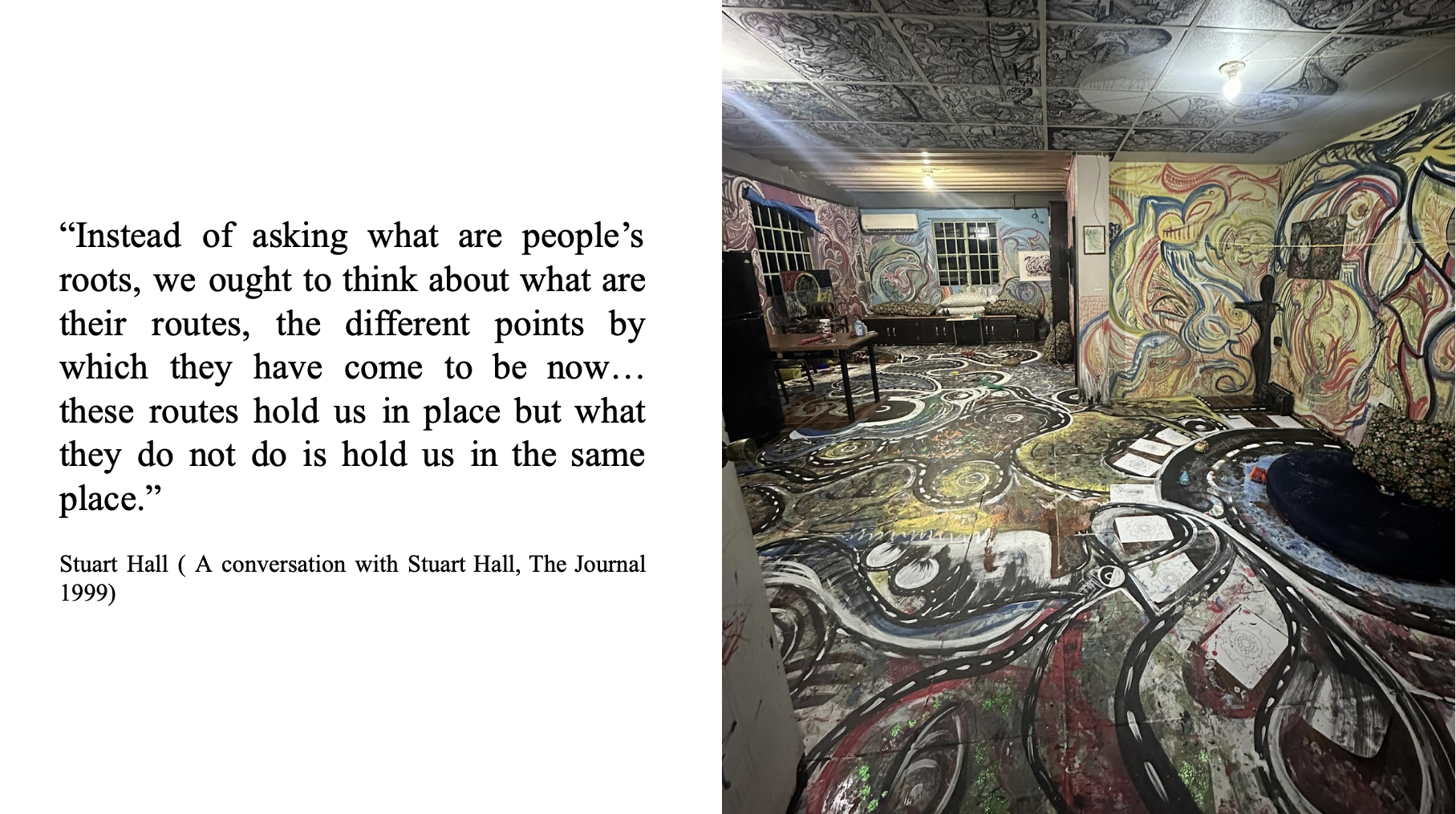
Cultural Exquilibrium
I use the concept of chemical equilibrium as a framework for interpreting these encounters. Applied metaphorically to festivals, equilibrium allows me to consider how cultural identities and traditions interact without necessarily resolving their differences. The festival acts as a container for encounters. Through participation and embodiment, these elements may influence one another, producing new meanings and possibilities for individual and collective transformation.
Festivals in multicultural societies provide a setting in which these routes become visible. Participants may gather in the same place while bringing different understandings, memories, and expectations to the celebration. The festival becomes a shared space without necessarily producing a shared or uniform meaning.
The mask can be viewed as a vehicle for this movement between states of being and becoming. Through masking, individuals enter a collective process without necessarily surrendering their differences.The aim is not to produce a uniform cultural solution. Instead, the festival makes room for multiple identities to coexist, intersect, and change at different rates. Some encounters may produce immediate recognition, while others require prolonged negotiation. Equilibrium therefore becomes a way of thinking about cultural continuity and change without assuming that either is ever complete.
The chemical model also raises questions about the relationship between festivals and the environments in which they occur. During a festival, participants may experience an intensified connection to place and community. The rhythms, rituals, and shared activities of the celebration can temporarily reorganise their attention, creating a sense of immersion in the present moment. The outside world may appear distant, even as its histories and political conditions continue to shape the event.
I consider this experience through the metaphor of a closed system: a temporary environment in which interactions become concentrated within a defined space and duration. However, festivals are not literally closed systems. They remain influenced by migration, colonial histories, economic conditions, religious institutions, and wider political realities. The metaphor instead describes the felt intensity of a shared moment, during which participants experience a temporary reordering of their relationship to the world.
The idea of equilibrium also invites consideration of stability over time. In a chemical system at equilibrium, concentrations remain constant because the forward and reverse reactions occur at equal rates. In a festival, the analogy is not a literal measurement of cultural elements but an attempt to understand how a temporary sense of balance might emerge through repeated rituals, coordinated movement, and collective participation.
The festival may therefore be understood as a space of temporary synchronisation. Participants move together, respond to shared rhythms, and contribute to an environment in which individual expression and collective experience remain in dialogue.
Homogeneous Equilibrium:
In chemical terms, homogeneous equilibrium describes a system in which the relevant reactants and products occupy the same phase. I use this concept metaphorically to consider celebrations occurring within the geographical and cultural contexts from which their associated myths emerge. Here, the relationship between place, ritual, and cosmology becomes central. Rather than examining traditions meeting through migration or diaspora, I consider how different ritual expressions associated with the same myth develop within a shared cultural setting.
SHIVRAATRI ⇌ Samudra Manthan + Baraat
Within some Hindu traditions, the Samudra Manthan provides a narrative framework for comemmorating Shivraatri. The relationship between Shiva and the cosmic poison he consumed produced from the churning of the ocean, inspire symbolic offerings of water and milk to the Shiva lingam that can be understood through devotional interpretations that associate these offerings with cooling Shiva. In other parts of India, Shiv Baraat is celebrated through processions that represent Shiva’s wedding to Parvati. These distinct ritual expressions demonstrate how religious narratives can be interpreted and embodied through different forms of celebration. The myth remains a point of connection, while the rituals through which it is commemorated vary across communities and locations.The comparison also invites reflection on how the meanings of a festival are shaped by the relationship between myth, place, and practice.
Where traditions are observed within their places of origin, the relationship between cosmology and landscape may differ from that of diasporic celebrations, where migration and cultural encounter contribute to the evolution of ritual.
Heterogeneous Equilibrium
In chemical terms, heterogeneous equilibrium involves substances in different phases. I use this concept metaphorically to consider traditions that retain distinct cultural and spiritual characteristics while encountering one another within the diaspora.
JOUVAY ⇌ Shivraatri.
Jouvay is a repository of cultural memory, history, and expression, celebrated on Carnival Monday before Ash Wednesday and recognised across the Caribbean diaspora. Shivratri, determined by the Hindu lunar calendar, is observed on the thirteenth lunar night of the dark fortnight of Phalguna. In Trinidad and Tobago, the two celebrations sometimes coincide, bringing distinct ritual practices into temporal and spatial proximity.
SAMUDRA MANTHAN ⇌ Caribbean Colonisation
Hindu cosmology provides another framework through which I interpret the Caribbean’s colonial history and the continuing negotiation of power, wealth, and cultural survival.The Samudra Manthan, or churning of the cosmic ocean, is a Hindu narrative in which the churning produces both poison and divine treasures. I place this narrative in dialogue with the historical Triangle of Trade, examining how violent circulations of empire, commodities, and labour transformed Caribbean societies. The relationship between Samudra Manthan and colonial history is not presented as a direct historical equivalence. Instead, the myth provides a conceptual language through which to examine the contradictions of a world in which destruction and renewal, exploitation and survival, remain entangled.
JOUVAY ⇌ Kambule + Baraat
This relationship explores how Jouvay might be interpreted through the intersecting cultural imaginaries of a multi-ethnic Caribbean society. By placing Kambule and Baraat in dialogue, I consider the ways processions, ritual characters, and embodied performances travel across histories and geographies while acquiring new meanings.
We align technical insight with disciplined execution to provide measurable gains across operational, financial, and strategic domains.