Five Jumbies of Jouvay
Five Jumbies of Jouvay are set amidst the night festivals of Jouvay and Shivratri. Each character is adapted to navigate the Kübler-Ross five stages of grief in a journey to reclaim cultural heritage. It redefines self and identity through traditional Mas characters and deities from Orisha and Hindu spirituality, referencing historical migration within the Caribbean and the cultural innovation emerging from these movements. This storytelling model explores worldbuilding through the three spheres of existence outlined in Yoruba Cosmology:
Act 1 - The Ancestral
Act 2 - The Living
Act 3 - The Unborn
Act 1 - The Ancestral
I- 5 Jumbies of Jouvay
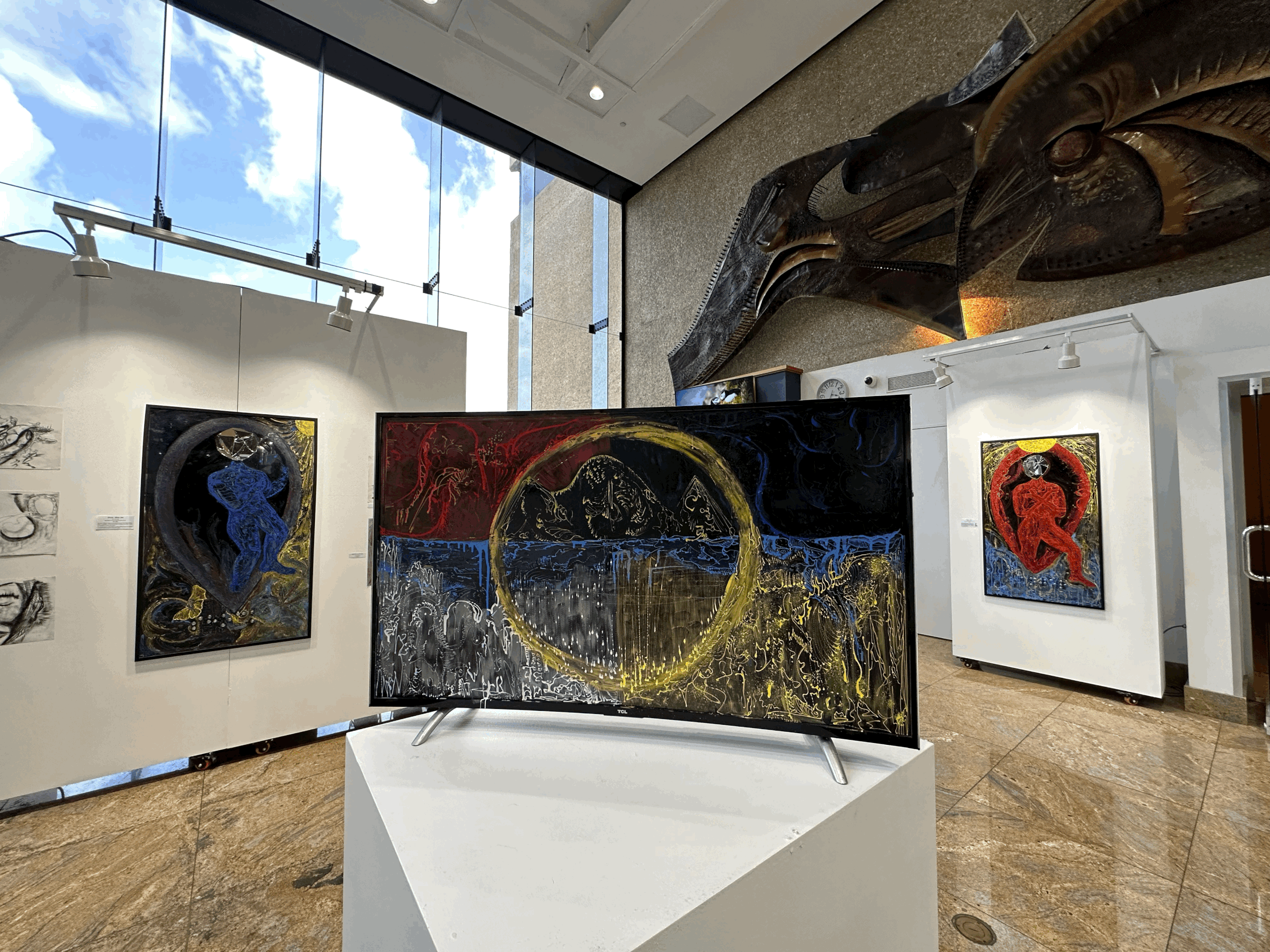
Displayed as part of the When the Night Changes Exhibition - Central Bank Museum 2024
The 5 Jumbies of Jouvay series draws on the rich history of Caribbean Carnival traditions, rooted in both celebration and resistance. This body of work highlights the historical and cultural intersections of Caribbean festivity and the struggles associated with colonization and loss. Each character in the series represents one of the Five Jumbies of Jouvay, drawing inspiration from the Bakongo Cosmogram to explore the cyclical stages of life and grief.
The emergence of Carnivalesque processions in the Caribbean is closely tied to a history marked by violence and loss. The “5 Jumbies of Jouvay” engage with this social history to uncover the past, raise awareness of current losses, and empower community creation. Each character in this artwork represents a specific stage of grieving. Inspired by the Bakongo Cosmogram, they are positioned according to life stages and the phases of the sun, following an anticlockwise path towards the rising sun, akin to traditional Jouvay parade routes that meet the rising sun.
The Bakongo Cosmogram principles inform the jumbies' appearance throughout life's changes. The sun’s phases represent the passage of time, while the portrait colours reflect the stages of life (birth, maturity, death, ancestral). Characters are placed within location pin emojis, symbolising a liminal space between life and death, inspired by a local saying that describes pregnancy as a metaphor for creation: “one foot in the grave and one foot out.”

Shock - Whip Jab
Glass paint on repurposed television screen
48 x 28 inches
Year: 2024
The name "Jab Jab" is derived from the French patois for "Diable Diable." Whip or rope jab is a Creole combination of African and Indian martial arts practised in Trinidad and Tobago.
The whip jab appears at the beginning of life, with the whip both inducing and awakening from shock in a duel with dawn.
Anger – Ogun
Glass paint on repurposed television screen
48 x 28 inches
Year: 2024
Orisha God Ogun, God of truth, justice and metal, transmutes anger with his hands in the position of nsibidi symbol of love. Nsibidi is a form of ideographic writing primarily employed by the Uguakima and Ejagham (Ekoi) people of Nigeria and Cameroon and found in the practices of the Ebe, Efik, Ibibio, Igbo and Uyanga communities.
Bargaining - Don Lorraine
Glass paint on repurposed television screen
48 x 28 inches
Year: 2024
Don Lorraine navigates uncertain times with the beauty of a Dame Lorraine, the mind of a Midnight Robber, and the heart of a Negue Jadin. Bearing a symbol of Sankofa on her chest, she retrieves her past to build a bridge between truth and beauty, moving us towards an understanding of justice that inspires peace. Sankofa is a Twi word from the Akan Tribe of Ghana that loosely translates to “go back and get it.
Depression – Moko
Glass paint on repurposed television screen
48 x 28 inches
Year: 2024
The "Moko" is an Orisha (God) of Retribution. This stilt-walking masquerade, regarded as a protector, uses its towering height to see and ward off evil. Appearing at midnight, the Moko Jumbie charts a course through the darkness of depression with its elevated view, guiding us when we are unable to see beyond our current circumstances.
II - 5 Mokos of Jouvay
Community as a Training Ground

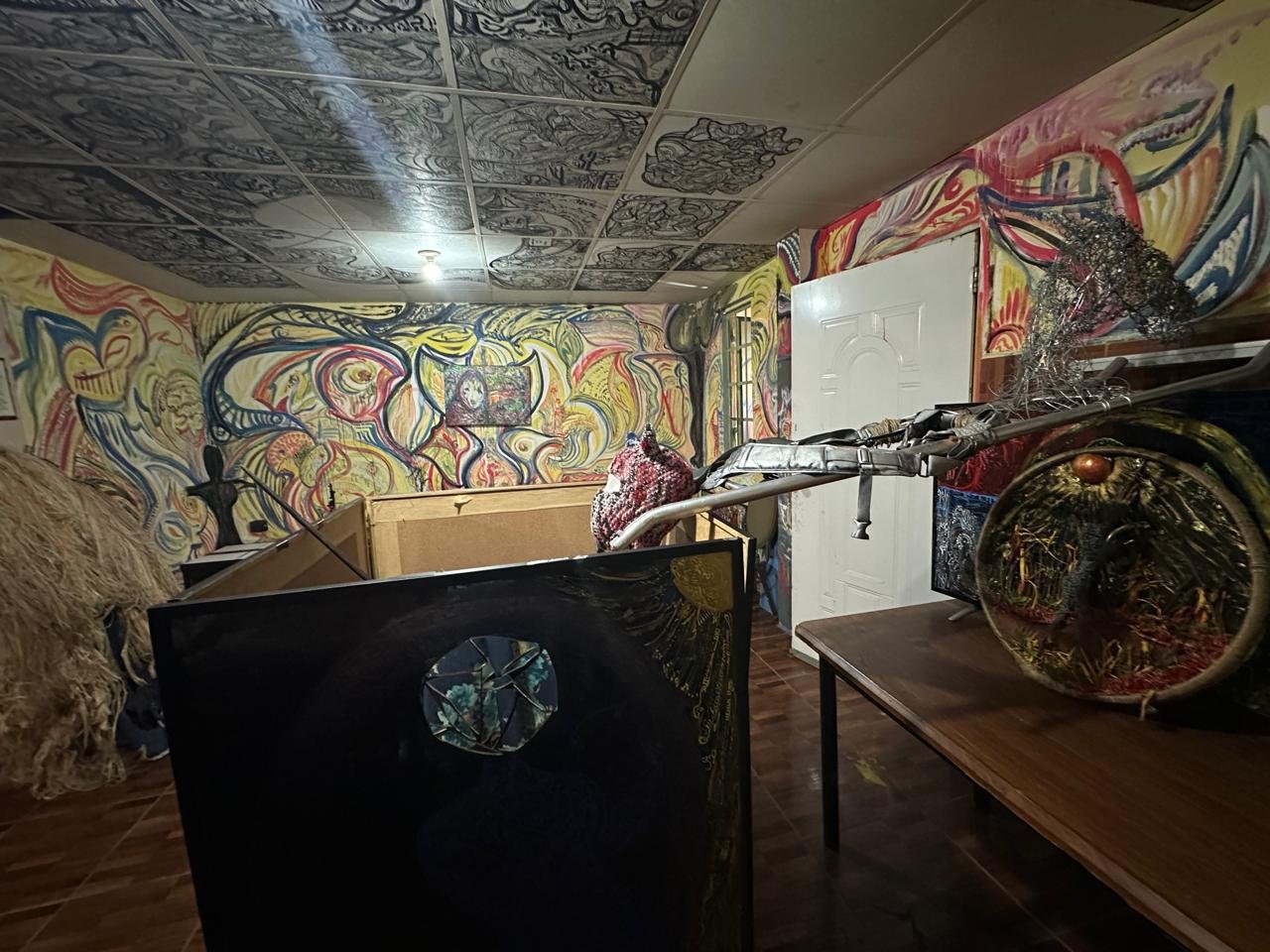
Displayed as part of the Playing Weself Exhibition - Central Bank Museum 2024
The "5 Jumbies of Jouvay" is used to explore the intricate layers of community through the Carnival character of the Moko Jumbie. Each figure embodies aspects of communal influence that are essential for personal transformation. These characters inhabit a symbolic training ground, a space where emotions are tested and where growth is nurtured, echoing the dynamic and often tangled nature of community ties.
In this space, the Jumbies coexist as our emotions do, overlapping and interacting in ways that may be difficult to recognize or separate. The project encourages viewers to reflect on how these emotional exchanges within community impact their journey.
What role does your community play in your personal transformation?
How does your environment shape your growth?
These questions invite explorations into the ways in which support, friction, and collective energy shape personal development.
Act 2 - The Living
In Search of the 5th Jumbie
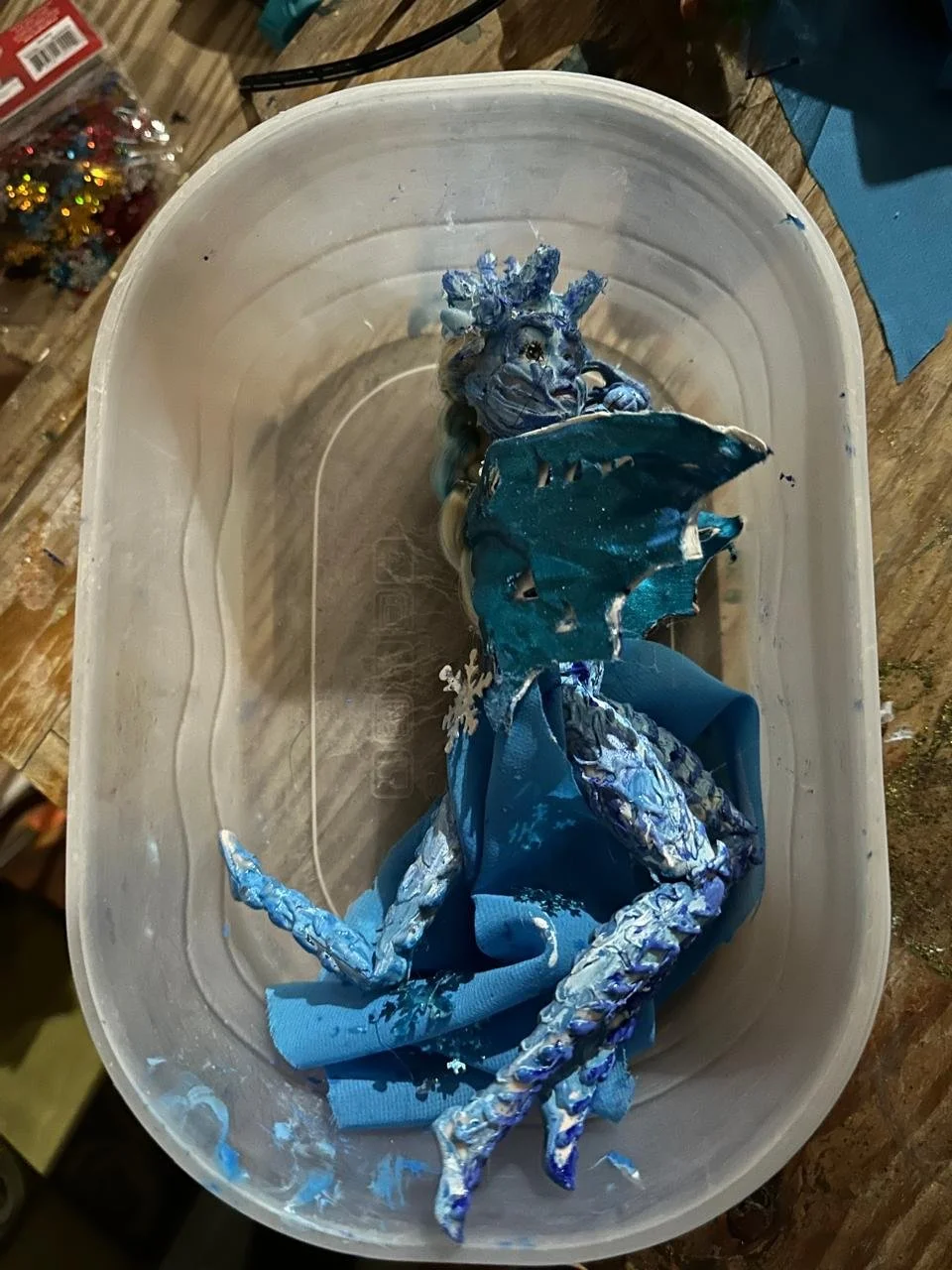
In this series, each jumbie embodies one of the classical elements—earth, air, fire, and water—awakening from long slumber in response to destructive human activity. Their return marks a call to restore balance where extractive practices have disrupted the natural world.
The Fire Jumbie ignites in the wake of industrial burning and fossil fuel consumption.
The Air Jumbie appears through the haze of polluted skies, responding to the slow poisoning caused by exhaust, emissions, and atmospheric neglect.
The Earth Jumbie rises in resistance to relentless quarrying, its body carrying the scars of landscapes stripped and unsettled.
The Water Jumbie emerges from melting ice caps and rising seas, bearing the grief and power of oceans pushed beyond their thresholds.
At the centre of the series exists the Fifth Jumbie—Ether. Invisible yet ever-present, this spirit guides the others, embodying connection, intuition, and the unseen forces that hold worlds together. Ether reminds us that restoration is not only material but spiritual: balance requires attending to what cannot always be touched, but can always be felt.


Act 3 - The Unborn

Mapping Acceptance
Displayed in Co-imagining the Soumayree Exhibition at Kazillion Kollectiv 2025
A maze of red and blue yarn weaves through the space, threading between the jumbies and binding them to the chair. These threads echo blood vessels— carriers of memory, lineage, entanglement. The maze becomes both a map and a metaphor: of enclosure and escape, unraveling and connection. It charts a journey that is as much inward as outward. Embedded in the seat of the chair is a final portrait:the Soumayree, cradling her own image astride a horse—a doubling of spirit, sovereignty, and myth.She marks the axis of the spiral. Acceptance here is not resolution, but deepening—a surrender to transformation, to living as art beyond creating from the chair.